
A patented fix for Lake Okeechobee's legacy phosphorus problem
A process that removes and permanently locks away phosphorus already settled at the bottom of the lake, without moving it off-site or relying on chemical treatment.
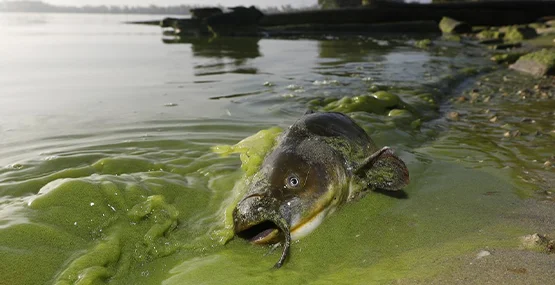
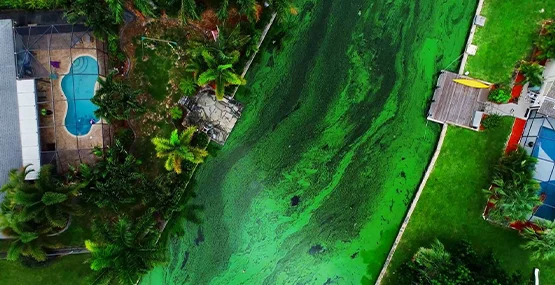
Decades of legacy phosphorus, still feeding every bloom
Decades of legacy phosphorus are locked into the fluid mud layer at the bottom of Lake Okeechobee. That sediment continues to feed harmful algal blooms long after a nutrient source is removed. Most existing approaches manage what's moving through the water column. Very few eliminate what has already settled on the lakebed. Learn More →
An in-lake process, built to run continuously
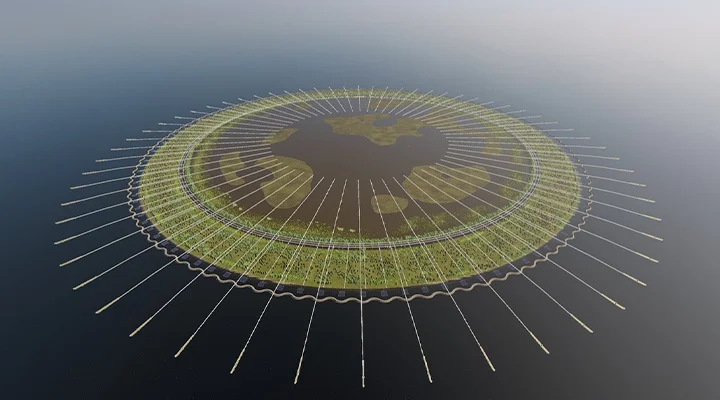
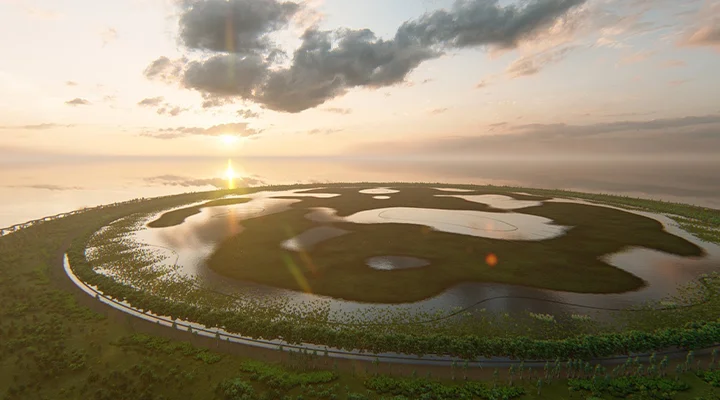
Diatom Lagoons draw down that fluid mud and sequester it permanently, using no chemicals and no off-site disposal. Solar-powered pumps move sediment from an outer trap into a contained interior lagoon, where it consolidates into new land over time and is planted with native vegetation, including pond apple trees that once lined the lake's southern shore. Cleaner water returns to the lake through a sand, rock, and limestone filter system, in a process designed to run continuously, indefinitely, entirely within the lake. Learn More →
U.S. Patent No. 11,795,646 B2
"System for Reducing Contaminants in a Body of Water." Issued October 24, 2023. Owned by Ironclad Siege, LLC. Invented by Keith Richardson.
Hedrick Brothers is a longtime South Florida contractor and builder committed to preserving the state's environmental heritage, the same commitment that led to the founding of its environmental division. As Director of Special Projects, Keith felt called to help revitalize this key water source for generations to come, in a manner designed to earn support from both policymakers and the public.
Collection
Solar-powered pumps draw fluid mud from an outer sediment trap into the lagoon interior.
Settling
Sediment consolidates inside the lagoon, gradually forming new land.
Phytoremediation
Native vegetation draws additional nutrients from the water as new land matures.
Discharge
Water passes through a sand, rock, and limestone filter before returning to the lake.
In-lake sequestration
Nutrients are collected, contained, and processed entirely within the lake. No land acquisition or off-site landfill required.
Continuous treatment
Collection, transport, and sequestration operate continuously and can remain in service essentially indefinitely.
Minimal process disturbance
Sediment capture happens within the outer trap under a low-gradient environment, minimizing dispersion through the water column.
No chemicals
Natural mechanical deposition and filtration, paired with phytoremediation, do the work. Nothing is added to the lake.
Habitat creation
New shoreline and land mass created through the process supports habitat for birds and aquatic species.
Renewable power source
The system is designed to run on solar power for the pumps required for operation.
A Complement, Not a Competitor
Chemical treatment binds phosphorus in the water column and can temporarily clarify it, but rather than removing the legacy sediment, it settles on top of it, where storms can resuspend it, and it does little or nothing for nitrogen. Diatom Lagoons remove that legacy phosphorus, nitrogen, and particulate load from the system permanently. By removing the pollutant load rather than just masking it, they increase the lake's usable water storage, and the clarity this creates lets light reach the bottom, giving submerged aquatic vegetation the conditions it needs to recover. Where chemical treatment offers a temporary fix for one symptom, Diatom Lagoons solve storage and water quality together, permanently.
WSP
Lead engineering firm. 138-year operating history, 63,000 professionals worldwide including 15,500 in the US. Twelve active FDEP contracts and a statewide Florida presence. Responsible for overall design, permitting, construction, and monitoring of the pilot program.
Hedrick Brothers Construction
Construction methodology, constructability, cost estimating, and scheduling input.
Diatom Lagoons LLC
Guidance and oversight of the Diatom Lagoons design and construction process.
0 yrs
WSP Operating History
0+
WSP Professionals Worldwide
0
Active FDEP Contracts Held by WSP
Regulatory Path Already Underway
- United States Army Corps of Engineers: Section 10/404 Permit
- WSP engaged as lead engineer in response to Florida DEP's ITN 2024016, "Water Quality Treatment to Combat Harmful Algal Blooms in Lake Okeechobee"