
The lake used to clean itself.
Lake Okeechobee’s problem isn’t just what flows into it today. It’s what has been accumulating on the lake bottom for decades.
Decades of legacy phosphorus, still feeding every bloom
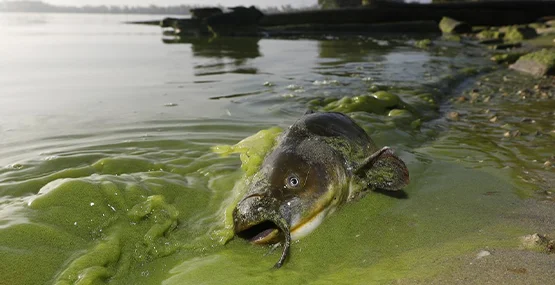
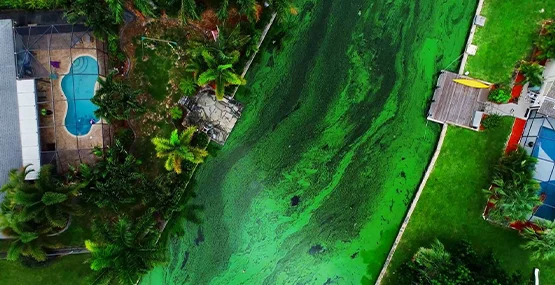
Decades of legacy phosphorus are locked into the fluid mud layer at the bottom of Lake Okeechobee. That sediment continues to feed harmful algal blooms long after a nutrient source is removed. Most existing approaches manage what's moving through the water column. Very few eliminate what has already settled on the lakebed.
What Changed
For thousands of years, water leaving Lake Okeechobee passed through roughly 30,000 acres of pond apple forest on its way south into the Everglades. That forest stripped nutrients out of the water. The lake worked as a lake: it took water in, cleaned it, and passed it on.
The Herbert Hoover Dike was built to protect the communities around the lake, and it did. It also ended the natural outflow that had cleaned the water for millennia.
Lake Okeechobee stopped being a lake that cleans itself and became a container.
What accumulated
Roughly 500 metric tons of phosphorus flow into the lake every year, primarily from the Kissimmee River and Taylor Creek. That figure is consistent with the peer-reviewed record, which puts inflow at over 500 metric tons per year across the past three decades.
Decades of that inflow have settled into a layer of soft, unconsolidated material on the lake bottom that scientists
The mud does not stay put. Lake Okeechobee is broad and shallow, and ordinary wind events resuspend the mud into the water column, where the nutrients feed blue-green algae and contribute to conditions that reach the estuaries on both coasts.
Why this repeats on schedule
The Florida Department of Health in Palm Beach County issued a blue-green algae health alert for Lake Okeechobee on February 23, 2026, lifted it on May 28, and issued a public caution on June 19. The Florida Department of Health in Martin County issued alerts on June 19 and again on July 24, 2026.
The alerts return because the source has not been addressed.
Why upstream work alone will not finish the job
Florida is spending billions to reduce what flows into the lake. Reservoirs, stormwater treatment areas, and agricultural best management practices are real, funded, and under construction, and they should continue.
But they treat what is arriving. They do not touch what already arrived.
That is the gap Diatom Lagoon fills, and it is why the two approaches are complements rather than competitors.
Why nobody has dredged it out
Florida is spending billions to reduce what flows into the lake. Reservoirs, stormwater treatment areas, and agricultural best management practices are real, funded, and under construction, and they should continue.
But they treat what is arriving. They do not touch what already arrived.
That is the gap Diatom Lagoon fills, and it is why the two approaches are complements rather than competitors.
Why upstream work alone will not finish the job
Florida is spending billions to reduce what flows into the lake. Reservoirs, stormwater treatment areas, and agricultural best management practices are real, funded, and under construction, and they should continue.
But they treat what is arriving. They do not touch what already arrived.
That is the gap Diatom Lagoon fills, and it is why the two approaches are complements rather than competitors.
Why nobody has dredged it out
Conventional dredging means removing hundreds of millions of cubic yards, treating the water squeezed out of it, finding somewhere on land to put material that carries mercury and pesticides, and buying that land. It also never ends, because nutrients keep arriving.
The most useful thing about the mud is also the most inconvenient: it is best dealt with where it already is.
Verify us: [ Protecting Florida Together, the state water quality dashboard ] · [ Read the Missimer, Thomas and Rosen paper ]